 By Meghna Sharma
Uranium is mined in relatively small quantities compared with iron ore or copper, yet it supports a vast share of the world’s nuclear electricity. Once extracted, uranium-bearing material is processed into a concentrated product commonly called yellowcake. The uranium then enters a separate chain of conversion, enrichment and fuel fabrication before it can be used in most commercial reactors. Ore grade, mining method and the cost of handling rock or groundwater determine whether a deposit can be developed competitively.
The largest source of new uranium is Kazakhstan, where in-situ recovery circulates a chemical solution through suitable underground deposits. Canada relies on exceptionally high-grade deposits in northern Saskatchewan, while Namibia operates large open-pit mines in an arid environment. Australia has extensive resources but produces much less than its geological endowment might suggest. These contrasting approaches make mine production a more useful measure than reserves, exports or nuclear-power capacity.
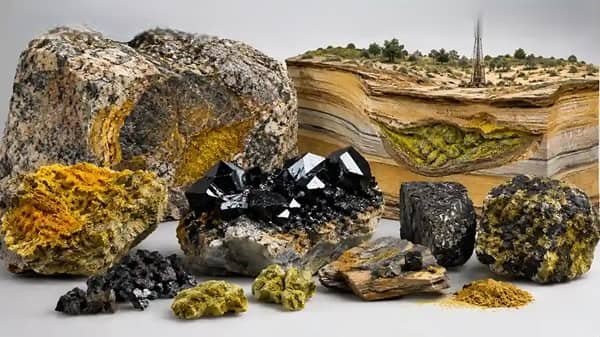
For a consistent international ranking available in 2026, the World Nuclear Association’s latest complete country table reports 2024 mine output in tonnes of contained uranium (tU). Later company results help explain industry developments but are not mixed into the country ranking. World output reached 60,213 tU in 2024; the ten leading countries listed below accounted for almost all of it.
Leading Uranium Producing Countries
| Rank | Country | Mine production (tU) | Reporting year |
| 1 | Kazakhstan | 23,270 | 2024 |
| 2 | Canada | 14,309 | 2024 |
| 3 | Namibia | 7,333 | 2024 |
| 4 | Australia | 4,598 | 2024 |
| 5 | Uzbekistan | 4,000 (est.) | 2024 |
| 6 | Russia | 2,738 | 2024 |
| 7 | China | 1,600 (est.) | 2024 |
| 8 | Niger | 962 | 2024 |
| 9 | India | 500 (est.) | 2024 |
| 10 | Ukraine | 288 (est.) | 2024 |
Production is the amount of uranium contained in material mined, not tonnes of ore or U3O8 concentrate. Estimates are labelled. The 2026 title indicates the year of this industry review, not a forecast of 2026 output.
1. Kazakhstan
Kazakhstan produced 23,270 tonnes of uranium in 2024, roughly 39% of the world’s mined supply. Deposits in the south of the country are particularly suited to in-situ recovery, which avoids bringing most of the host rock to the surface. Kazatomprom and international joint ventures operate numerous wellfields, including projects linked to Inkai, South Inkai and the Khorassan area. Output is sensitive to acid availability, wellfield development, transport and the pace at which new areas can be brought into production. Kazakhstan’s scale is considerable, but dependence on specialised chemicals and export corridors remains a practical constraint.
2. Canada
Canada mined 14,309 tU in 2024, keeping it the world’s second-largest producer. Its industry is concentrated in Saskatchewan’s Athabasca Basin, where ore grades at established deposits can be unusually high. Cigar Lake and McArthur River are major underground mines; the associated McClean Lake and Key Lake mills process material from these operations. Cameco and its partners must manage complex ground conditions, radiation protection and long northern supply routes. High ore grades allow substantial contained-uranium production from relatively limited mined tonnage, which is why ore weight alone would misrepresent Canada’s position.
3. Namibia
Namibia’s mines supplied 7,333 tU in 2024, a little over 12% of global uranium output. The Husab and Rössing operations are large open-pit mines near the Namib Desert, where ore is moved in considerable volumes before processing. Husab is associated with China General Nuclear interests, while Rössing is controlled by China National Nuclear Corporation. The mines have important infrastructure and employment effects, but low rainfall, water sourcing, electricity availability and management of tailings demand careful attention. Namibia’s growth has made it a pivotal supplier even though its extraction conditions differ sharply from Kazakhstan’s in-situ wellfields.
4. Australia
Australia produced 4,598 tU in 2024 despite possessing one of the world’s largest uranium resource inventories. Olympic Dam in South Australia obtains uranium alongside copper, gold and silver; the Beverley/Four Mile district has used in-situ recovery. The Ranger mine in the Northern Territory has ceased uranium production, illustrating why past mining importance should not be treated as current output. Development decisions reflect state and federal regulation, community consultation, mine economics and the scale of investment required. Australia’s position shows that large reserves do not automatically translate into a leading annual mining volume.
5. Uzbekistan
Uzbekistan’s estimated production was 4,000 tU in 2024. The Central Asian country uses in-situ recovery across uranium-bearing geological formations, with its state mining industry centred on the Navoi region. The technique can lower surface disturbance where the deposit and groundwater chemistry permit controlled recovery. Uzbekistan’s annual statistics are less transparent than those of some listed mining companies, so the international table marks its figure as an estimate. Development depends on wellfield preparation, reagent supply and the capacity to process and market concentrate under long-term international arrangements.
6. Russia
Russia produced 2,738 tU in 2024. Domestic uranium mining is managed within the Rosatom group, including operations in the Trans-Baikal area and projects associated with Priargunsky and Dalur. Russia also participates in uranium production overseas, particularly through interests connected to Kazakhstan; those foreign tonnes belong to the country where the uranium was mined, not to Russia’s national total. Mining performance depends on ore quality, underground costs and in-situ operations. The country’s prominent role in enrichment and other nuclear-fuel services should not be confused with its more modest domestic uranium-mine ranking.
7. China
China’s estimated uranium mine production was 1,600 tU in 2024. Domestic operations form only one part of the country’s nuclear-fuel supply strategy, which also includes overseas mining participation and imported uranium. Chinese mining interests are important in Namibia and Kazakhstan, but uranium extracted abroad is reported under the host country’s output. Within China, geological exploration and development of suitable in-situ recovery areas are intended to improve security of fuel supply. The output estimate is substantially below the scale of China’s nuclear construction programme, underlining the distinction between uranium mining and reactor fuel demand.
8. Niger
Niger produced 962 tU in 2024, down from much higher levels earlier in the decade. The uranium industry is concentrated around Arlit in the north, where mining has supported economic activity for decades but also raised difficult questions about water, rehabilitation and local benefits. Operations associated with Orano have faced interruptions amid political and commercial disputes, and the future of various projects has become uncertain. The 2024 figure records actual mine supply in that year; it should not be replaced with a larger nameplate capacity or with historical exports. Niger remains geologically important even when annual production declines.
9. India
India’s uranium production was estimated at 500 tU in 2024. Domestic mining, undertaken by Uranium Corporation of India Ltd, serves the country’s civilian nuclear-fuel requirements alongside imported supplies. Jharkhand has long been a centre of extraction, while projects in Andhra Pradesh include the Tummalapalle deposit. Uranium ore can be relatively low-grade, placing emphasis on careful milling, tailings management and operational efficiency. Indian production figures in international compilations are estimates, and the quantity of fuel consumed by its reactors is not an appropriate substitute for measured domestic mine output.
10. Ukraine
Ukraine’s estimated uranium production reached 288 tU in 2024, compared with 340 tU in 2023. Its known uranium mining districts are mainly associated with central Ukraine and the Eastern Mining and Processing Plant. War-related disruptions, energy constraints and investment difficulties have affected the wider mineral sector. The international ranking uses only mined uranium in the relevant year, not estimated resources or fuel obtained from abroad. At this level of output, Ukraine placed ahead of the United States, which produced 260 tU in the same table. Both estimates and small differences at the bottom of the ranking warrant caution.
Uranium Supply Developments in 2026
Nuclear-power operators need dependable fuel deliveries many years ahead of reactor use. That encourages long-term uranium contracts even when spot-market prices change sharply. In-situ recovery now supplies more than half of global mined uranium and is particularly significant in Kazakhstan and Uzbekistan. High-grade Canadian mines, however, remain valuable because the concentration of uranium in the rock can offset demanding underground conditions. Mine restarts and exploration projects are attracting interest, but permitting, capital spending, technical work and environmental obligations mean a proposed project cannot immediately become new supply. The most useful indicators are recovered tU, mine availability, development spending and contract commitments rather than promotional resource estimates.
Understanding Uranium Production Figures
The World Nuclear Association’s 2024 dataset, updated in 2026, is the consistent basis for the ranking. One tonne of contained uranium is not one tonne of U3O8: the chemical conversion factor is approximately 1 tU = 1.179 tonnes U3O8. Mine production must also be distinguished from uranium reserves, conversion services and supplies released from stockpiles. Figures for Uzbekistan, China, India and Ukraine are identified by the source as estimates.
Frequently Asked Questions
Q. Can a country operate nuclear power plants without mining uranium?
Yes. Reactor operators can import uranium and arrange conversion, enrichment and fuel fabrication through suppliers in other countries. Domestic uranium extraction is not a requirement for generating nuclear electricity, which is why the largest mining countries and the largest nuclear-power markets are not the same.
Q. What happens to radioactive waste after a uranium mine closes?
Milling tailings and contaminated materials require regulated management after production ends. Closure plans may involve engineered containment, treatment of affected water, rehabilitation of disturbed land and environmental monitoring over many years. The measures depend on the site and the mining method.
Q. Can recycling used nuclear fuel reduce the need for newly mined uranium?
It can. Some countries recover uranium and plutonium from used reactor fuel for manufacture into new fuel, including mixed-oxide fuel. Recycling makes better use of existing material, but it is not practised everywhere and does not remove the need for fresh uranium supplies.
Q. Why do nuclear utilities maintain uranium inventories?
Uranium passes through several industrial stages before a reactor can use it. Utilities therefore secure supplies well before scheduled refuelling and may hold inventories to manage transport delays, processing outages or interruptions at mines. The buffer helps separate short-term mining problems from power-station operations.