 By Meghna Sharma
A log is the beginning of several different manufacturing chains. Straight, high-quality stems become construction lumber, plywood or veneer; smaller or less uniform material is often chipped for paper pulp, fibreboard and engineered panels. Species, diameter, moisture and the distance to mills determine a log’s practical value. Softwoods such as pine and spruce dominate many structural uses, while eucalyptus, poplar and tropical hardwoods serve pulp, furniture and specialist markets. Timber production is consequently shaped as much by forest management and industrial access as by the number of trees standing in a country.
The clearest international measure is industrial roundwood, expressed in cubic metres. It covers logs and other roundwood harvested for industrial processing but excludes wood collected principally as household fuel. FAO estimates that global industrial-roundwood production reached approximately 1.956 billion cubic metres in 2024. Country figures for that year provide a common basis for examining the major suppliers entering 2026; some figures are FAO estimates rather than direct national returns. The ten producers below account for most of the world’s commercially harvested industrial logs.
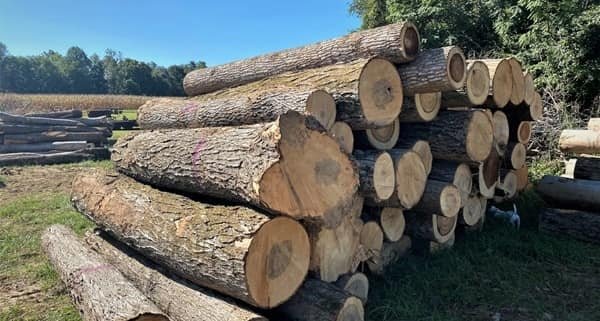
Largest Industrial Roundwood Producers
| Position | Country | Output, million m³ | Approximate global share |
| 1 | United States | 319.1 | 16.3% |
| 2 | Brazil | 199.7 | 10.2% |
| 3 | Russia | 193.1 | 9.9% |
| 4 | China | 190.9 | 9.8% |
| 5 | Canada | 114.9 | 5.9% |
| 6 | Indonesia | 91.8 | 4.7% |
| 7 | Sweden | 64.9 | 3.3% |
| 8 | Finland | 54.6 | 2.8% |
| 9 | India | 49.9 | 2.6% |
| 10 | Germany | 47.3 | 2.4% |
Figures are rounded FAOSTAT forestry data for industrial roundwood, not sawn timber, paper or fuelwood. Several country totals include estimated observations.
1. United States
The United States produced 319.1 million m³ of industrial roundwood in 2024, about 16.3% of the reported world total. Southern pine plantations across Georgia, Alabama and neighbouring states feed sawmills, plywood operations and pulp mills; the Pacific Northwest supplies Douglas fir and other softwoods for structural lumber. Privately managed timberland plays an important role, although ownership patterns vary regionally. Fast-growing southern forests support regular harvest cycles, while western production faces wildfire, permitting and environmental constraints. Housing construction determines much of the demand for sawlogs, whereas packaging and tissue manufacturing draw on pulpwood. A single harvest can supply several product streams.
2. Brazil
Brazil produced approximately 199.7 million m³ of industrial roundwood in 2024. Major plantations in the south, southeast and parts of the interior support large integrated pulp mills, including substantial export operations. Fast tree growth gives Brazilian producers comparatively short rotation periods. This commercial plantation system must be distinguished from logging in the Amazon, where forest law enforcement and traceability remain critical. Production growth also depends on infrastructure, rainfall and land-use safeguards rather than plantation area alone.
3. Russia
Russia produced an estimated 193.1 million m³ of industrial roundwood in 2024. Its boreal forests contain extensive pine, spruce, larch and birch resources, concentrated across Siberia and European Russia. Geographic abundance does not automatically translate into competitive output: long haul distances, difficult winter access, limited roads and processing capacity constrain harvesting. Changes in export destinations and sanctions have also altered traditional timber-trade routes. Domestic sawmilling and pulp investment help capture more value than exporting raw logs, but financing and equipment access remain important practical limits.
4. China
China produced an estimated 190.9 million m³ of industrial roundwood in 2024. Poplar and eucalyptus are important fast-growing species, alongside pine and other timber resources. The country also remains a major importer of logs and processed timber because furniture, construction, packaging and panel industries exceed domestic supply for many species. Forest protection policies limit certain forms of natural-forest harvesting, increasing the importance of commercial plantations. Pulp and engineered-board manufacturers depend on consistent fibre quality, making domestic planting programmes strategically significant.
5. Canada
Canada produced approximately 114.9 million m³ of industrial roundwood in 2024. British Columbia, Québec, Ontario and Alberta contribute different forest types and industrial products. Softwood sawlogs support construction lumber exports, while pulpwood feeds paper and fibre facilities. Much commercial harvesting occurs on publicly owned land under provincial management systems. Wildfire, mountain pine beetle damage, timber availability and disputes over softwood-lumber trade with the United States affect output and profitability. Mills must often adapt to smaller logs or changing species mixes as accessible forest resources shift.
6. Indonesia
Indonesia produced an estimated 91.8 million m³ of industrial roundwood in 2024. Industrial estates on Sumatra and Kalimantan connect large fibre plantations with processing facilities and port infrastructure. Tropical hardwoods also have a place in the sector, but legal-origin documentation and forest-conversion concerns are central to international market access. Certification, peatland management and fire prevention carry commercial as well as environmental consequences. The distinction between plantation wood and timber extracted from natural forests is essential when evaluating sustainability.
7. Sweden
Sweden produced around 64.9 million m³ of industrial roundwood in 2024. Sawmills and pulp producers are closely integrated, allowing smaller logs, chips and residues to be used across several industries. Private family forests coexist with large corporate holdings. Swedish producers benefit from established logistics and forest research, but biodiversity rules, conservation debates and energy costs increasingly shape harvesting decisions. Export demand for packaging materials and engineered timber provides additional support beyond conventional housebuilding.
8. Finland
Finland produced approximately 54.6 million m³ of industrial roundwood in 2024. Its forestry network links private woodland owners to sophisticated pulp, paperboard, sawmilling and engineered-wood plants. Industry groups including UPM, Stora Enso and Metsä Group depend on stable fibre supplies, although their operations extend beyond Finland. Wood availability has become more sensitive to forest-growth conditions, climate pressures and changing imports from neighbouring countries. Efficient transport and sorting are crucial because different mills require different species and diameters.
9. India
India produced an estimated 49.9 million m³ of industrial roundwood in 2024. Industrial wood comes from plantations, farm forestry and regulated forest sources, with eucalyptus, poplar and other species supplying plywood, panels, paper and packaging. Agroforestry in northern states provides a commercial market for trees grown alongside crops. Demand from housing, furniture and packaging manufacturers remains strong, leading to imported wood and pulp where domestic supplies are insufficient. Smallholder participation and variable log quality make procurement different from large northern-hemisphere forestry systems.
10. Germany
Germany produced about 47.3 million m³ of industrial roundwood in 2024. Spruce and pine support a modern sawmilling industry, while beech and oak have important higher-value uses. Drought, bark-beetle damage and storms have changed the timing and species composition of timber supply in several regions. Salvage harvesting can temporarily raise volumes while reducing the long-term availability of healthy mature stands. German mills serve domestic construction and export markets, but structural change towards mixed and more climate-resilient forests will influence log assortments over coming decades.
Timber Industry Developments in 2026
Manufacturers increasingly seek traceable fibre, engineered-wood products and greater use of sawmill residues. Mass timber construction may raise demand for structural-grade lumber, but it does not remove fire-safety or building-code requirements. Wildfires, drought and pest outbreaks complicate harvesting plans across temperate and boreal forests. In tropical supply chains, legality checks and land-use safeguards remain central to export access. Short-run production figures therefore need to be read alongside forest renewal and harvest sustainability.
Understanding the Figures
The volumes are based on FAO’s 2024 forest-products statistics for industrial roundwood. Estimated observations are included where national returns were incomplete; figures are rounded to one decimal place. Roundwood output is not interchangeable with sawnwood production, timber exports or the area of standing forest. FAO estimates world output at 1,956 million cubic metres for 2024.
Frequently Asked Questions
Q. Is industrial roundwood the same as timber used in buildings?
No. It also includes logs and smaller wood used for pulp, fibreboard, plywood and other industrial purposes.
Q. Why is fuelwood excluded?
Household firewood and energy wood serve different markets and would distort comparisons of commercially processed timber.
Q. Do countries with the largest forests harvest the most logs?
Not necessarily. Road access, ownership, processing mills, conservation policy and demand all affect commercial harvesting.
Q. Can plantation wood replace natural-forest timber?
Plantations provide large volumes of uniform fibre, but they do not reproduce the biodiversity or specialist hardwood species of natural forests.