 By Meghna Sharma
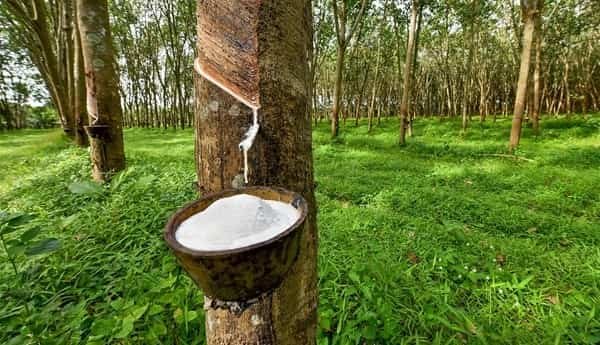
Natural rubber starts as a milky latex tapped from the bark of Hevea brasiliensis trees. Farmers make shallow cuts in the bark, collect the latex and sell it to processors who turn it into sheets, block rubber, concentrated latex and other commercial grades. Its elasticity, resistance to repeated flexing and ability to form strong compounds make natural rubber essential to tyres, vibration mounts, medical products and countless industrial components. Synthetic rubber can replace it in some applications, but the two materials are not interchangeable in every product.
Production depends on more than the number of trees planted. Rubber trees generally need several years before tapping, and output varies with rainfall, disease, tree age, farm maintenance and labour availability. Smallholders account for a major share of the crop in Southeast Asia. Thailand remains the largest supplier, while Indonesia is a longstanding export producer. Côte d’Ivoire has expanded particularly quickly, placing West Africa firmly among the leading rubber regions. Vietnam, China and India combine plantation production with major domestic processing or tyre industries.
The ranked table uses a single FAOSTAT 2024 country series for natural rubber in primary forms to avoid joining conflicting national estimates. More recent 2025 industry estimates are discussed separately where useful: GAPKINDO reported roughly 14.90 million tonnes of global production in 2025. The figures below measure natural rubber produced, not tyre output, synthetic rubber or the value of rubber-product exports.
Leading Natural Rubber Producing Countries
| Rank | Country | Production (tonnes) | Reference year |
| 1 | Thailand | 4,789,042 | 2024 |
| 2 | Indonesia | 2,262,088 | 2024 |
| 3 | Côte d’Ivoire | 1,686,599 | 2024 |
| 4 | Vietnam | 1,327,473 | 2024 |
| 5 | China | 877,600 | 2024 (intl. figure) |
| 6 | India | 876,000 | 2024 (intl. figure) |
| 7 | Cambodia | 527,200 | 2024 (intl. figure) |
| 8 | Malaysia | 386,512 | 2024 |
| 9 | Philippines | 364,557 | 2024 |
| 10 | Laos | 350,300 | 2024 (intl. figure) |
The ranking follows the FAOSTAT-based 2024 series; some values are international-agency estimates. Thailand, Indonesia and Côte d’Ivoire remain the top three in GAPKINDO’s separately reported 2025 overview, but the two series should not be mixed into one ranking.
1. Thailand
Thailand produced about 4.79 million tonnes of natural rubber in 2024, representing nearly one-third of the world total in the FAOSTAT-based series. Production is concentrated in the south, with additional cultivation in other suitable regions. Smallholders supply latex and cup lump to dealers and processors, which manufacture technically specified rubber, sheets and concentrated latex. Thailand’s large export-processing network serves tyre and industrial manufacturers around the world. Weather, leaf disease, tapping labour and competition for land shape farm output. Industry statistics for 2025 also placed Thailand first, at approximately 4.79 million tonnes.
2. Indonesia
Indonesia produced approximately 2.26 million tonnes in 2024, ranking second. Rubber cultivation is important in Sumatra and Kalimantan, where extensive smallholder areas coexist with larger estates. Traditionally, Indonesia has exported sizeable volumes of technically specified rubber used by tyre manufacturers. Low yields on ageing plantations, disease, changing crop economics and farmers switching to other crops have constrained production. GAPKINDO’s 2025 country overview indicated output near 2.04 million tonnes, a decline from the 2024 FAOSTAT-based figure; the change should be assessed with attention to the different statistical sources and reporting methods.
3. Côte d’Ivoire
Côte d’Ivoire harvested approximately 1.69 million tonnes of natural rubber in 2024, making it the third-largest producer in the harmonised series. Its plantation industry has grown through expansion by smallholders and investment in processing capacity. The crop provides an income source across southern and western production areas and has become an important export commodity. Unlike some Asian countries facing older tree stands, Côte d’Ivoire has benefited from relatively recent plantings entering tapping age. Rapid growth also increases pressure for land-use traceability, appropriate land management and adequate domestic processing. GAPKINDO’s 2025 overview put production near 1.99 million tonnes.
4. Vietnam
Vietnam produced about 1.33 million tonnes in 2024. The country has an established plantation sector, with major growing areas in the southeast and Central Highlands, and strong connections to downstream manufacturing and regional trade. Vietnamese businesses process natural rubber into grades for export and domestic use, including tyre and engineering applications. Productivity depends on skilled tapping and careful management of tree age, while global selling prices influence the incentive to maintain plantations. Imports of rubber for processing and re-export also mean that export volume cannot be treated as identical to rubber tapped on Vietnamese farms.
5. China
China produced roughly 877,600 tonnes in the 2024 country series, placing fifth just ahead of India. Natural rubber is cultivated in tropical and subtropical areas such as Hainan and Yunnan, where winter temperatures can limit the tapping season. China is also an exceptionally large consumer because it manufactures tyres and other rubber goods for domestic and export markets. As a result, its rubber imports far exceed the scale of domestic farming. A 2026 Chinese industry white paper reported 922,000 tonnes of domestic output for 2024 using a different national measure, illustrating why mixed sources should not be used to force precise rankings.
6. India
India produced approximately 876,000 tonnes of natural rubber in the 2024 international series. Kerala has historically been the leading rubber-growing state, while cultivation has expanded in northeastern India and other suitable areas. The Rubber Board supports improvements in tapping, planting material and farmer productivity. India’s tyre and engineering sectors consume more natural rubber than domestic producers supply, so imports are an important part of the market. The closeness of the China and India figures makes fifth and sixth place sensitive to revisions. India’s rubber industry is best understood by comparing farm output with industrial consumption, not by exports alone.
7. Cambodia
Cambodia produced an estimated 527,200 tonnes in the 2024 FAOSTAT-based series. Rubber cultivation has developed through both estate concessions and smaller farms, supported by proximity to manufacturing and processing markets in Asia. Raw rubber and processed forms are important agricultural exports, but foreign trade can vary independently from the harvest because stock levels and processing schedules change. The industry faces challenges around plantation productivity, farmer incomes, land rights and chain-of-custody documentation. Other country-level statistical series report different volumes for 2024, so the number here should be read within the particular harmonised source, not as a definitive national census.
8. Malaysia
Malaysia produced 386,512 tonnes of natural rubber in 2024. Although it once dominated global rubber supply, the country has shifted substantial agricultural land and investment toward other crops, particularly oil palm. Malaysia nevertheless remains influential in downstream rubber processing and products such as gloves, which should not be mistaken for the quantity of latex tapped locally. Smallholders continue to form a substantial part of domestic farming. Labour availability, ageing trees and farm-gate prices affect annual output, while rubber-product factories often use imported raw material. The country’s industrial importance is therefore considerably greater than its current farm-production rank.
9. Philippines
The Philippines produced about 364,557 tonnes of natural rubber in the 2024 FAOSTAT-based compilation. Production is associated mainly with Mindanao, especially areas where suitable tropical conditions support plantation crops. Rubber provides livelihood opportunities for growers who may sell cup lump or latex to local traders and processors. The sector is smaller than those of Thailand or Indonesia but contributes to domestic demand for tyres, footwear and industrial products. Harvest conditions, farm organisation, access to processing and consistent quality affect profitability. Some alternative agricultural datasets produce substantially lower estimates, so comparisons require a clearly identified source and commodity definition.
10. Laos
Laos produced an estimated 350,300 tonnes of natural rubber in the 2024 harmonised series, completing the top ten. Plantations expanded through investment and cross-border links with neighbouring countries, especially China and Vietnam. A relatively small domestic manufacturing base means that raw-material trade is important to the sector. Trees take years to reach tapping age, so acreage planted earlier can determine current output more strongly than short-term changes in prices. Land-use issues, farmer contracts and transport costs remain central concerns. The 2024 figure is an international statistical estimate, not a measure of rubber goods manufactured inside Laos.
Natural Rubber Industry Developments in 2026
The balance between natural rubber supply and industrial consumption remains tight enough to make weather and farm decisions important for tyre manufacturers. The Association of Natural Rubber Producing Countries projected around 15.31 million tonnes of world natural rubber production in 2026, compared with about 14.97 million tonnes in 2025. Disease, prolonged rain, wintering and insufficient tapping labour can alter harvests. Processors are also investing in traceability because customers increasingly want evidence about land use and supply-chain origin. Meanwhile, stronger African production is diversifying a market long centred on Southeast Asia. Farmers’ long investment cycle means supply often responds slowly to a change in price.
How Rubber Production Is Compared
The complete top-ten ranking uses FAOSTAT’s 2024 natural-rubber production series as presented by Commodity Origins and the World Signal Monitor; international-source figures are marked in the table. The 2025 GAPKINDO overview and 2026 ANRPC outlook provide more recent industry context, not directly interchangeable replacements for individual 2024 observations. Production is measured in tonnes of primary natural rubber. Synthetic rubber, finished tyres, rubber gloves and exports of imported material are excluded.
Frequently Asked Questions
Q. Why is rubber output not measured as the weight of fresh latex?
Fresh field latex contains water and other non-rubber material. Buyers and statistical agencies therefore use dry-rubber content, or the equivalent weight of marketable natural rubber, rather than treating every kilogram of liquid collected from a tree as a kilogram of rubber.
Q. Why do heavy-duty tyres still need natural rubber?
Natural rubber offers valuable resistance to tearing and repeated flexing under heavy loads. Truck and bus tyres often use a high proportion of it for durability, while tyre makers also blend synthetic rubbers and additives to achieve the required traction, wear and temperature performance.
Q. Can commercial natural rubber come from plants other than rubber trees?
Researchers and manufacturers are developing rubber from guayule, a shrub, and the Russian dandelion. These plants could diversify agricultural supply, but they do not yet match the commercial scale of Hevea brasiliensis plantations, which remain the dominant global source.
Q. What does vulcanisation do to natural rubber?
Vulcanisation forms links between rubber polymer chains, usually with sulphur-based systems. It makes the finished material more elastic and durable across a useful range of temperatures. Raw plantation output and a vulcanised product such as a tyre are therefore different stages of the industry.